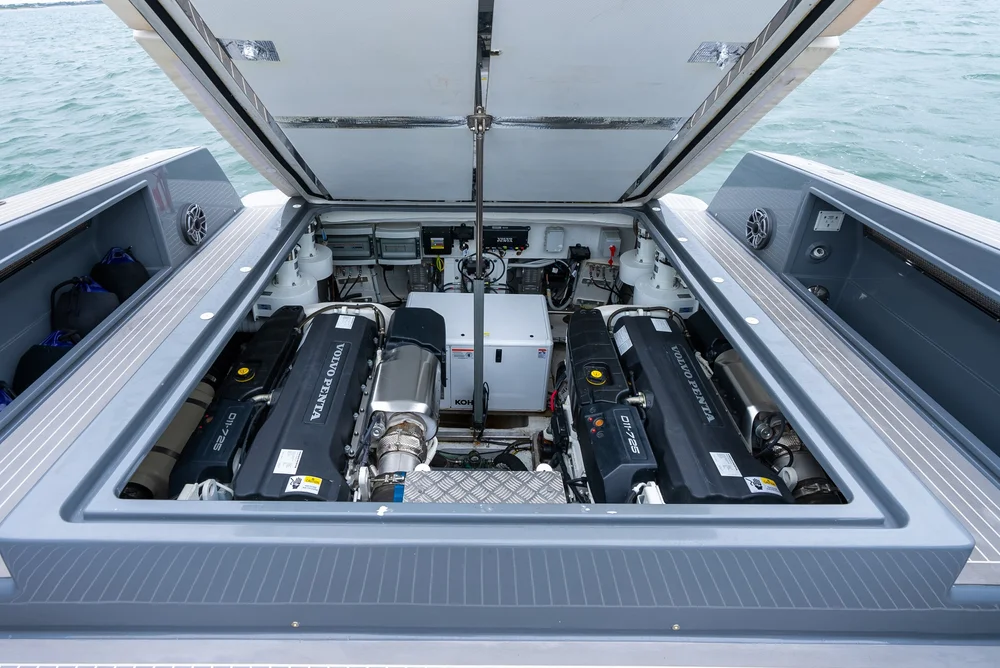
Almost every answer you will find to this was written about a wake boat or an outboard. That is fine if you are buying a wake boat. However, it is close to useless if you are looking at a boat with a pair of diesels in it.
So let me give you the version that actually applies.
How many hours is too many on a boat engine, honestly
It depends far more on how the hours went on than on what the meter reads. A diesel with 2,400 hours of cruising is a better engine than the same diesel with 900 hours of idling.
The first one is the better bet. The second one needs a close look from the engine surveyor before anyone signs anything.
The meter is a starting point for a conversation. It is not a verdict.
What the numbers actually look like
For a baseline, Discover Boating puts the average marine gasoline engine at about 1,500 hours before a major overhaul, and the average marine diesel at around 5,000. Well maintained diesels reach 8,000. Still, those are market averages, so treat them as a frame rather than a promise.
| Engine type | Typical hours before major work | What usually kills it first |
|---|---|---|
| Gas inboard or sterndrive | 1,000 to 1,500 | Exhaust manifolds and risers corroding out, long before the block wears |
| Modern four stroke outboard | 2,000 to 3,000 | Missed service intervals and long periods of sitting |
| Light duty common rail diesel | 3,000 to 5,000 | Injectors, turbos, and long hours at idle |
| Commercial rated diesel | 8,000 and up | Time and corrosion, usually before the bottom end wears |
Notice what is in the right hand column. Almost none of it is the part of the engine that hours are supposed to measure.
Service is the thing. Hours are the byproduct.
Idle hours are the expensive ones
A diesel wants to work. Run one at light load for hours and it never reaches proper temperature. As a result, fuel does not fully burn, carbon builds on the valves and rings, and unburned fuel washes down the bores into the oil.
In the trade that gets called wet stacking. In practice you can often smell it before you can measure it.
Now think about how a boat in South Florida actually gets used. It idles out of a canal. Then it sits at the sandbar with the engines on. After that it creeps through a no wake zone for twenty minutes each way, and runs hard for fifteen minutes in the middle.
So two boats with 600 hours each can be in completely different condition. The one that ran offshore is usually the healthy one.
If you have found a boat and have not talked to a broker about it yet, text me the listing.
Low hours are frequently the worse problem
Buyers get excited by a small number. In my experience, though, a boat that has barely moved is the harder one to own. Sitting is its own kind of wear.
Seals dry out and shrink. Fuel goes off and grows things. Injectors gum. Batteries sulfate. Raw water impellers take a permanent set in the shape of the housing, then shed vanes the first time you load them.
Meanwhile exhaust systems rot from the inside, where you cannot see them.
That last one is not theoretical for me. On a sea trial with buyers aboard, an exhaust connection let go. The engine room filled with black smoke and water.
The cause was a fiberglass exhaust tube that had gone soft where the rubber elbow met it, just past the turbo. Water gets trapped between the rubber and the fiberglass. It never dries, so it rots the tube from the inside out. Consequently the failure is invisible until somebody pulls the elbow off.
That boat had about 1,000 hours and had sat a lot over the years, with salt water lying against a joint nobody ever opened.
The meter itself can be wrong
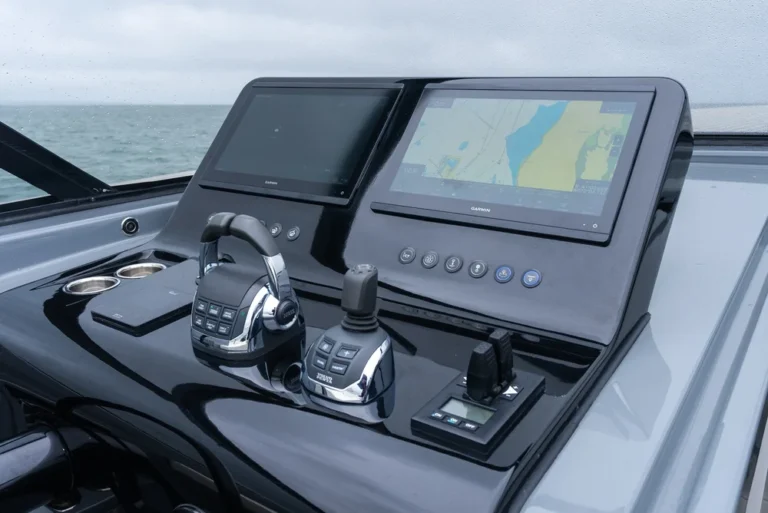
Hour meters get replaced. Displays get swapped.
So cross check it. On any modern common rail diesel the engine control unit keeps its own log, and a dealer can pull it. Volvo does this through VODIA, Cummins through Insite, and the rest have an equivalent.
What comes off that download is not just total hours. You also get load histogram data, which shows how long the engine spent in each RPM band. In addition you get fault codes, plus any overspeed or overtemperature events.
That report is one of the most useful things the engine survey gives you.
In practice, once you have the histogram in front of you, how many hours is too many on a boat engine stops being a guess and becomes arithmetic.
Read the boat, not just the engine
Wear is consistent. If the meter says 400 hours, the rest of the boat should agree.
- Helm seat bolster, wheel, and the finish on the throttle handles
- Wear through the non skid at the boarding gate and on the swim platform
- Rope grooves on cleats and chafe on the anchor roller
- Cushion compression on the seats people actually sit in
- Stainless worn thin at the handholds people actually grab
For example, a 400 hour meter on a boat with worn cleats and a flattened helm bolster means somebody has run it a lot more than the dash admits.
Found a boat you like?
If you have not talked to a broker about it yet, text me the listing.
What the engine survey should give you
I recommend an engine surveyor on every deal. Ask the engine surveyor for all of this in writing.
- The ECU download, including the load histogram, from an authorized dealer
- Oil analysis on both engines and the gears, taken from oil that has been run
- A cold start, with nothing warmed up beforehand
The cold start is the one you can do yourself, for nothing, and it is the most honest test on the list. Similarly, white smoke that hangs around, a rough first thirty seconds, or a laboring starter will tell you more than the meter ever will.
After that, the running side of the inspection belongs on the water. My sea trial checklist covers what to do with the engines once you are moving, and this piece on water damage covers what to look for around them.
Common questions
Is 1,000 hours a lot for a boat engine?
For a diesel, no. That is early middle age, and a well kept engine has thousands left. By contrast, a gasoline inboard at 1,000 hours is approaching the point where manifolds, risers and possibly a rebuild belong in your budget.
How many hours per year should a boat have?
Roughly 50 to 100 hours a year is normal for a South Florida owner who uses the boat properly. Much less, and ask how long it sat between runs. Much more usually means a charter or delivery history worth knowing about.
Do engine hours or age matter more?
Age and use pattern usually matter more than the raw count. After all, most marine engines are retired by corrosion, heat and neglect rather than by wearing out. An eight year old engine with 900 well spread hours normally beats a twenty year old engine with 400.
Can you tell engine hours from the service records?
Often, yes, and it makes a good cross check. Dealer invoices usually note the hour reading at the time of service, so a run of invoices gives you a rough curve. A curve that jumps or flattens oddly is worth a question.
The rule I use
If you take one thing from this, take the answer to how many hours is too many on a boat engine in its simplest form. Buy the maintenance, not the meter.
Given the choice between a higher hour boat with a thick folder of dealer invoices and a low hour boat with nothing, I take the folder every time. So should you.
If you have found a boat and have not talked to a broker about it yet, text me the listing. Frank Christopher, 954 504 8367.