Most people picture the same thing when they think about ordering new. A blank sheet, a designer, and a boat built exactly the way they want it. That is not what ordering a production dayboat is.
The new boat build process is not that. What it actually is: a place in a factory schedule, a short menu of choices, a payment calendar, and a delivery clause that decides what the price on the quote really means. The parts that go wrong are almost always the same parts. None of them are the fun parts.
Here is the whole sequence, in order, with the places people get hurt marked.
What a build slot actually is
A slot is a position in the production schedule for one model, inside a defined factory window. It is not a reservation you can move. One dealer promotion this year spelled it out plainly: the offer applied only to the next available slot, and it could not be banked or used later.
Slots attach to a hull number, and that hull number is not a marketing label. On a boat built in the EU it is a 14 character number set under EU rules, not by the yard. Buried in that string is the month and year of production.
Check it. Build date and model year are two different things, and they can be a long way apart. If someone tells you a 2027 boat and the CIN says it was molded in early 2026, that is worth a question.
Bigger boats have fewer slots. A smaller model might have twenty units scheduled in a year. A larger one might have a handful.
What you actually get to choose
This is where the blank sheet idea dies, and honestly it should. A production build sheet is short. Twenty or so line items, organized into the same categories every time: paint, deck finishes, upholstery, interior layout, engines, electrical, electronics, and a catch all at the end.
Within those categories the choices are real and they matter. Paint runs from a standard non metallic, up through metallic, up again to a custom color outside the builder’s sample book, and each step is a meaningful number. Deck options cover things like a hydraulic swim platform, a bimini, a refrigerated cockpit table. Interior might offer one alternative layout. Engines usually offer one step up in horsepower plus joystick control and a warranty extension.
Anything not on that list goes in as a special request, and the yard prices it separately on its own timeline.
The customization you actually get scales with size. Around 30 to 60 feet you are choosing finishes, hull color and engine package. Layout and deck configuration open up closer to 65 or 70 feet. Genuinely bespoke interiors start around 100.
That is not a criticism of production builders. A short menu is why the boat gets delivered on a schedule and why the fit and finish is consistent. But go in expecting a menu, not a blank page.
Why the layout locks before almost anything else
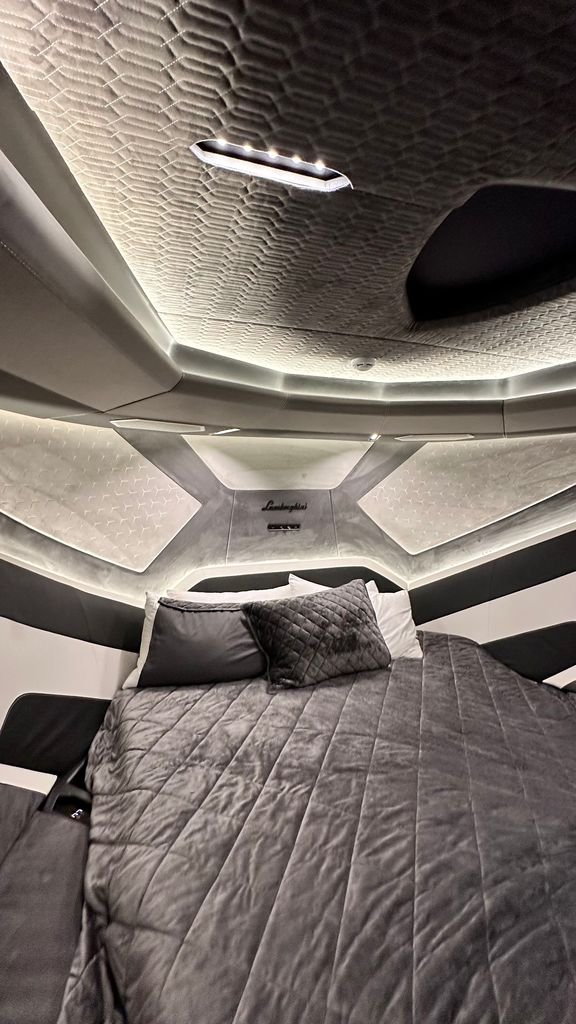
Here is the engineering reason nobody explains. On a production boat the interior furniture modules are structural. They stiffen the hull. The yard bonds them in before the deck goes on.
Once the deck is joined to the hull, the layout is finished. Not expensive to change. Finished.
Which is why builders want the boat fully specified at order, with the first payments made, before anything starts. That 2026 dealer promotion I mentioned required exactly that: fully specified, first two payments in, before the window closed. Specification and money lock together, up front.
Plan accordingly. The time to be indecisive is before you sign, not in month four.
How the money goes in
Money is where the new boat build process gets real. The common shape is a deposit around 20 percent at signing, then four or five stage payments tied to verifiable build milestones, then a balance on delivery.
The word doing the work there is verifiable. A good milestone is discrete and you can photograph it. Engine installation is a good one. Interior fit out is a bad one, because it is a long continuous process with no obvious moment where it is done.
Two things to push for, and I would push hard on both:
- Hold money back past delivery. Keep a percentage until commissioning and sea trials are finished and the punch list is cleared. Once the yard has all the money your leverage is gone.
- Understand what your deposit is sitting in. In Florida, yacht brokers must place transaction funds in a trust account at a qualifying institution under Chapter 326. But that same chapter exempts new yacht sales from the licensing requirement. I am a broker, not a lawyer, and I am not going to tell you what that means for your money. I am telling you it is a question worth putting to a marine attorney before you wire a deposit on a new build, and that the answer may not be what you assume.
For what it is worth, the deposit protections people talk about at the top of the market, refund guarantees from a bank, escrow arrangements, progressive transfer of title, are standard on superyacht and commercial shipbuilding contracts. I have found no evidence they reach production boats. Do not assume you have one because you read about it.
The clause that decides what the price means
If you read one section of this, read this one. It is the single biggest source of nasty surprises and it is completely avoidable.
A quote on a European built boat carries a set of delivery terms, and those terms decide who pays for freight, who pays for insurance, who pays the import duty, and who carries the risk if something happens mid ocean. The shorthand comes from the Incoterms rules.
- Ex works. The boat is yours at the factory gate. You pay freight, insurance and duty. You are also responsible for export clearance out of a country where you probably have no legal presence, which is why the ICC itself warns this term is really meant for domestic trade.
- FOB. Yours once it is on board the ship. You pay the ocean freight, insurance and duty from there.
- CIF. This is the one that catches people. The seller pays the freight to the destination port, so it feels like a delivered price. But risk passes to you the moment the boat is loaded at origin. A boat damaged mid Atlantic on CIF terms is your loss, even though the seller bought the freight. And the seller only has to carry minimum named perils cover, not all risks.
- DDP. Delivered, duty paid. The only common term that puts import duty on the seller.
Where does your number stop?
That is the question to ask any builder or dealer, in those words.
Some quotes stop at the yard door and the freight, the duty, the marine insurance and the commissioning arrive later as separate invoices. Others are landed, duties paid and commissioned, with US configuration and export paperwork already handled. Both can be honest quotes. They are not the same number, and the gap between them is not small.
On the VanDutch builds I handle, the price I quote is landed Fort Lauderdale with duties, transport, marine insurance and commissioning inside it, which is why I can tell a client what the boat costs rather than what the boat costs before the other bills show up. Both current build slots are listed here, the 2027 VanDutch 48 and the 2027 VanDutch 56.
One more precision point. The classic terms above were written for cargo loaded aboard a ship. A yacht riding on a semi submersible transporter, or delivered on its own bottom, does not fit that model cleanly. That is a conversation for a freight forwarder, not something to assume.
What it costs to land a European boat here
Verified 11 September 2026. Tariff policy has moved repeatedly since early 2025, so confirm the current rate with a licensed customs broker before you rely on it.
The base duty on yachts and motorboats under HTS heading 8903 is 1.5 percent. Since 24 July 2026, an extra duty on EU built boats brings the total to 10 percent. CBP’s guidance to the ports assigns EU goods with a base rate under 10 percent to a combined 10 percent rate.
So the arithmetic is 1.5 percent base plus 8.5 percent additional, totaling 10 percent of customs value. Not 1.5. Not 15. Ten.
Two qualifications that matter. Customs value is the ex works or FOB price, not the landed cost, because the entry excludes international freight and insurance when you identify them separately. And if you are looking at an aluminum or steel hulled boat rather than composite, there is a separate metals regime that may apply, so get that checked specifically.
If you imported in 2025, you may be owed a refund
If you took delivery of a European boat between February 2025 and February 2026, you likely paid under a tariff regime the Supreme Court struck down, and CBP has opened a refund process. The catch is that only the importer of record or the filing customs broker can claim. If your dealer was the importer of record, that is a contract conversation with your dealer, not a customs one. I wrote more about the tariff situation in the post on US tariffs on boats.
Florida sales tax, and the $18,000 ceiling
Sales and use tax is 6 percent, capped at $18,000 per boat, and the cap includes the county surtax. Six percent reaches the cap at a $300,000 purchase price, which means every boat above that pays a flat $18,000. That cap is the reason a lot of large boats close in Florida rather than somewhere without one. Full detail is in the Florida boat sales tax post.
If you are a Florida resident taking delivery in Florida, there is no offshore closing trick. The nonresident affidavit and decal program exist for genuine nonresidents, and the affidavit is sworn.
What happens when the boat gets here
Customs release is rarely the slow part. Expect roughly four to six weeks from arrival to a boat you can actually use.
The paperwork nobody mentions until it bites:
- Coast Guard compliance at entry. The importer has to declare that the boat meets US safety standards. A CE mark from Europe is not a substitute. These are separate regimes.
- Hull identification number. A US importer of a foreign built boat has to obtain its own Coast Guard manufacturer identification code and apply a conforming US format HIN. If that is wrong or missing, Florida registration stops dead, because the HIN is on the paperwork the tax collector needs.
- EPA. Your engines need valid EPA certification. European yards building for the US market spec US certified engines so this is a formality. A boat originally built for the European market with EU only engines is a real problem, not a paperwork nuisance.
Then commissioning, which is the dealer’s make ready scope and has no regulatory definition. Uncradling, launch, systems commissioning, installing anything dealer fitted, the pre delivery inspection, punch list, sea trial, and handover. The engine’s first scheduled service is often what activates the engine warranty, so do not skip it. My sea trial checklist applies to a new boat as much as a used one.
Documentation, registration, and the charter question
Florida gives you 30 days from purchase to title and register. For a new boat you need the manufacturer’s certificate of origin, and it has to show the HIN. Apply at a county tax collector, not at FWC.
Federal documentation through the Coast Guard is separate and slower. A boat of at least five net tons wholly owned by US citizens is eligible. A foreign built boat can get a recreational endorsement. Documentation exempts you from Florida titling, but you still need Florida registration and the decal.
Here is the one that catches people planning to offset costs. A foreign built boat cannot get a coastwise endorsement. That means it cannot legally carry passengers for hire between US points. If your plan involves chartering the boat to help pay for it, an EU built hull closes that door before you start. Find that out now, not after delivery.
Warranty, and the two clocks you need to line up
Volvo Penta moved to a three year global marine warranty for products delivered from 2025, with years four and five covering major components. Yards typically sell an extension on top of that as a line item on the build sheet.
The trap is that the clocks do not necessarily start together. Engine warranty is supposed to start when the boat is delivered to the first customer, but check it. On a 2023 model year boat advertised as new, my Volvo dealer showed the engine warranty had already started when the boat was delivered to the dealership. Hull warranty commonly starts when the dealer puts the boat into service. If your boat lands in Fort Lauderdale and then sits for three months waiting on a commissioning slot, those two periods can drift badly out of step, and you can burn months of engine coverage on a boat you have never run.
Ask both questions in writing before delivery. What date does the engine warranty start, and what date does the hull warranty start.
The market right now, and why it matters to you
Lead times on European production boats have shortened, and the reason is demand weakness rather than new factory capacity. Groupe Beneteau reported a marked contraction in order intake from March 2026 and cut distribution inventory by nearly 40 million euros in the second quarter. Builders are running campaigns advertising boats available immediately, and dealer promotions with benefits that decay month by month to fill slots.
Nobody structures a decaying discount when they have a queue.
For a buyer that is leverage, and it is the kind that does not last. It shows up as a better slot, a better delivery date, or options included rather than discounted. Ask for all three.
What I would tell you to do
None of the new boat build process is hard once you know the order it happens in. Order new if you want a specific configuration, a full factory warranty starting fresh, and you can live with a date that might move. Buy used if you want the boat this season and you would rather spend the difference on a proper survey. Neither answer is wrong. They are different trades.
If you do order, do these five things:
- Get the delivery terms in writing and establish exactly where the quoted number stops.
- Confirm the current duty rate with a licensed customs broker on the day, not from a blog post, including this one.
- Tie stage payments to milestones you can photograph, and hold money back past sea trial.
- Get both warranty start dates in writing before you accept delivery.
- Finish the spec before you sign. After the deck goes on, the layout is decided.
I handle VanDutch build slots and I am happy to walk you through a build sheet line by line, including which options hold value at resale and which ones you will wish you had skipped. That conversation costs you nothing and it is a lot cheaper than finding out in month six.
Call or text 954 504 8367 and tell me what you are thinking about. If a used boat is the better answer for you, I will tell you that too.