Most buyers think the survey covers the engines. It does not.
That single misunderstanding costs people more money than anything else in a boat purchase. They pay for a survey, get a clean report, close, and then discover the motors were never opened, never tested beyond a temperature reading, and never anybody’s responsibility.
So before you book one, understand exactly what you are buying and what you are not.
What does a marine survey cover?
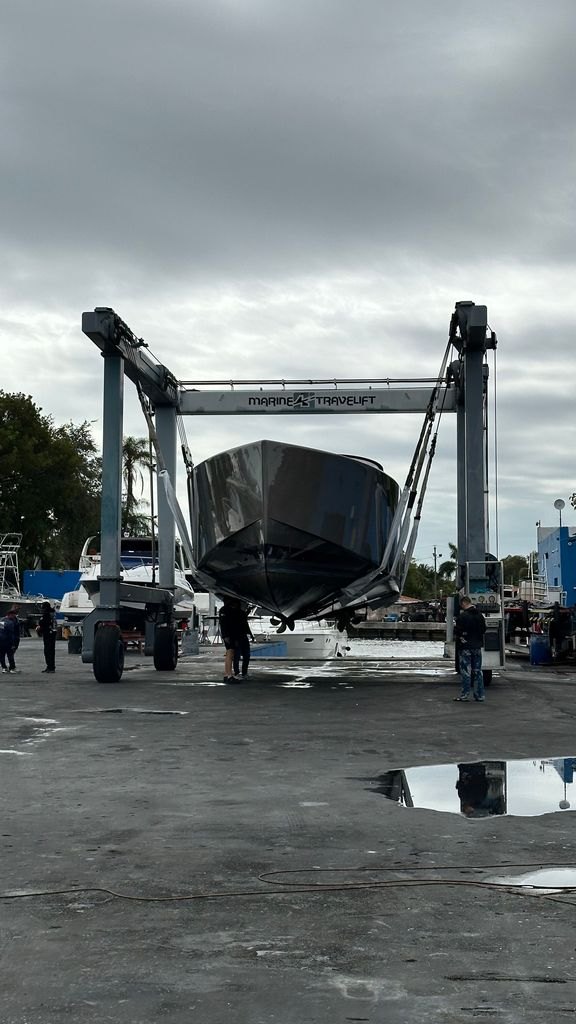
A standard pre-purchase survey, sometimes called a condition and value survey, is a nondestructive visual inspection by an accredited surveyor. In practice that means the hull is checked after a haul out and pressure wash, systems are run to confirm basic operation, safety equipment is checked against regulation, and the surveyor gives an opinion on condition and value.
Concretely, you should expect:
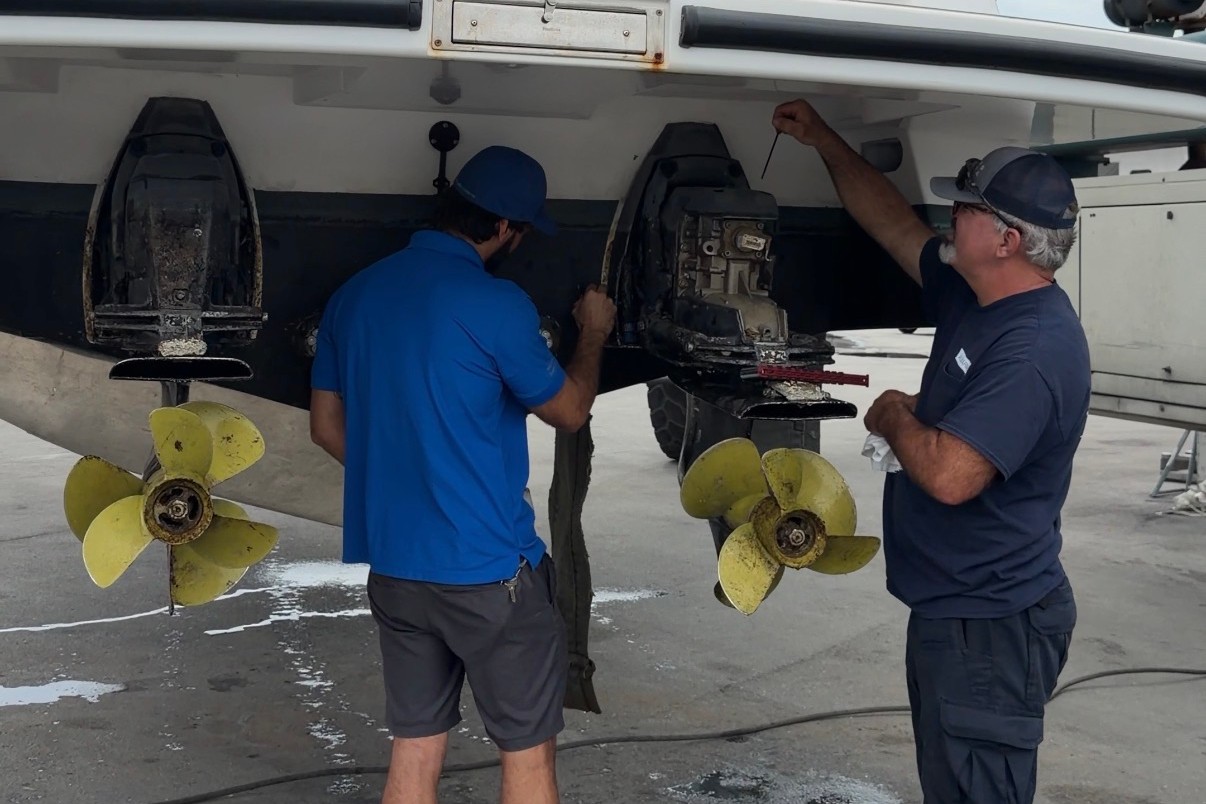
- Hull, keel, rudder, running gear and through hulls, inspected out of the water
- Moisture readings on the deck, transom and hull as an indicator of water intrusion
- Structural inspection of stringers and bulkheads, where they are visible
- Electrical system checked against ABYC and Coast Guard requirements
- Steering, throttle and shift linkage operation
- Plumbing, tanks, seacocks, hoses and clamps
- Fire, safety and navigation equipment against regulation
- A sea trial on a powerboat, with the surveyor aboard
- A written report with findings and a value opinion, in a form insurers and lenders accept
What does a marine survey not cover?
Four things: engine internals, which need a separate engine survey; anything behind a permanent structure, since the surveyor will not take fixed parts apart; seaworthiness beyond the condition on that one day; and any guarantee that a component will not fail next month. This is the half nobody advertises, and the half that matters.
1. Engine internals. The engine survey is a separate service, done by a separate specialist, starting around $1,200 in South Florida. A hull surveyor will note obvious problems and then tell you to get an engine man. That is correct practice and it is not a gap in their work. Meanwhile the engines are typically the most expensive thing on the boat.
2. Anything behind a permanent structure. The surveyor will not disassemble fixed parts of the boat to see what is behind them. No cutting, no pulling headliners, no removing a bonded panel. If a problem lives behind glass or under a moulded liner, it stays there.
3. Seaworthiness. A survey describes condition on one day. Whether the boat is fit for a specific passage depends on the voyage, the weather and the crew, and no surveyor signs off on that.
4. A guarantee. Nothing in the report promises a component will not fail next month. It is a snapshot, taken by a professional, of what was visible on that date.
If you have found a boat and have not talked to a broker about it yet, send it to me and I will tell you which specialists it warrants on top of the general surveyor.
Does one surveyor inspect the whole boat?
No. There is no single person who inspects everything. The general surveyor covers the vessel as a whole and writes the condition and value report your lender and insurer will ask for, and each major component has its own specialist. That usually means two or three separate people.
The general surveyor is a generalist by design. He looks at the vessel as a whole, gives you the structure, the systems and the regulatory picture, and writes the condition and value report your lender and your insurer will accept. What he is not is an expert in any one of the expensive things bolted into the boat.
Who does what
| Who | What they actually check | When you need one |
|---|---|---|
| General or hull surveyor | Structure, hull, through hulls, systems operation, safety and regulatory compliance, condition and value opinion | Always. This is the report insurers and lenders accept |
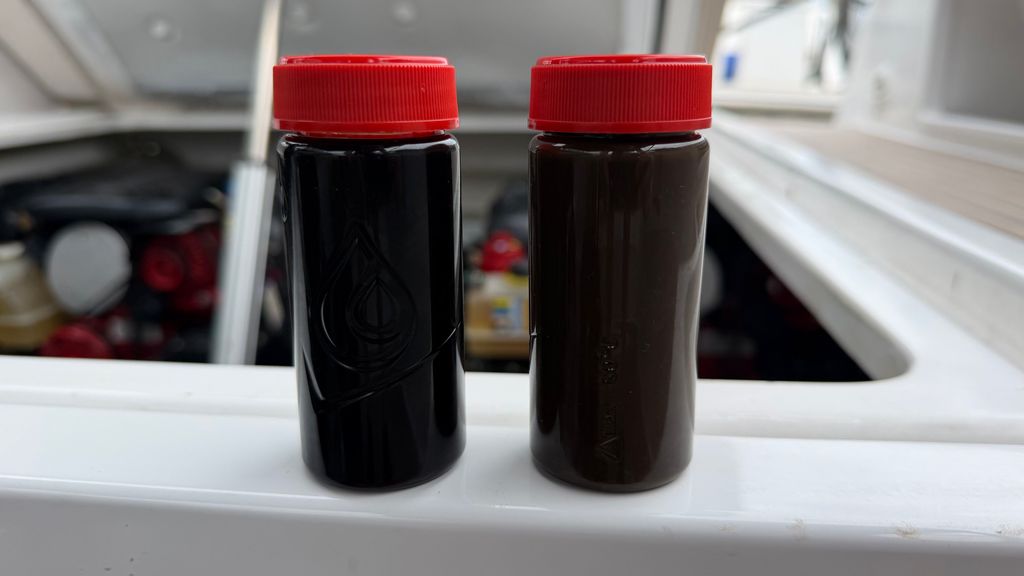
| Engine surveyor | Compression or leak down, ECU download and load history, oil and coolant analysis, temperatures under load, gear and alignment | Any boat, inboard or outboard. Starts around $1,200 and climbs from there with the engines |
| Stabilizer technician, gyro or fin | Run hours against service interval, bearing and seal condition, service history from the manufacturer, behavior under way. On a fin system, the hydraulics, the actuators and the shaft seals where the fins pass through the hull | Any boat with a gyro such as a Seakeeper, or with fin stabilizers fitted |
Why the specialist beats the generalist here
It is not only that they know the component better. More importantly, an authorized technician can pull the real service history out of the manufacturer’s system.
A Seakeeper tech can tell you what that unit has actually done and when it was last serviced, rather than what the seller remembers. An engine dealer can pull the load histogram off the ECU. Consequently you get facts instead of assurances, and that is worth far more than the call-out fee.
A good general surveyor will tell you which of these to bring in. If he does not raise it, ask him directly which components on this particular boat he wants a specialist to look at.
Do you need a separate engine survey when buying a boat?
Yes. The engine survey is the single most likely thing to reprice a deal or end one, and a hull surveyor does not open the engines. I am a broker telling you to spend money that can cost me a sale, so take that as seriously as it deserves.
Compression comes back uneven, the ECU shows a history nobody disclosed, the oil analysis finds coolant.
What people get wrong about it
These come up a lot, and none of them hold up.
- “The survey covers everything.” It does not, and anybody in the business knows it does not
- “The engines were just serviced, you do not need it.” A service invoice is not a compression test. Those are different facts
- “Do not bother with the haul out, the bottom was done last year.” The haul out is where the hull inspection happens
What to do about it
I recommend an engine surveyor on every deal, including outboards. A broker who does not recommend one is a red flag. How the buyer’s side gets paid is in the piece on commission.
What does a high moisture reading on a boat survey mean?
It means look closer, not walk away. A high reading is a prompt to investigate further, not proof of a wet core or a structural problem. Buyers tend to panic at one and sellers tend to argue with it, and both reactions miss what the number actually is.
A moisture meter measures relative readings through a surface. It does not tell you whether the core is wet, how long it has been wet, or whether it matters structurally. Consequently the reading is a prompt to look harder, usually with a sounding hammer, a thermal camera or a core sample, and sometimes with a follow up after the boat has dried.
A good surveyor will say exactly that in the report. In other words, treat a moisture note as an open question, not a finding.
How much does a boat survey cost in South Florida?
Costs scale with age as much as length, because an older boat takes longer.
- Pre-purchase survey, starting around $1,200
- Short haul and pressure wash, roughly $14 to $19 per foot
- Engine survey, starting around $1,200 and climbing with the engines
- Component specialists, quoted per visit
- Sea trial fuel and a captain, which are the seller’s cost, not yours
Everything above the sea trial line is the buyer’s cost. In practice, on a 45 ft boat with twin diesels and a gyro, that is a real number before you own anything.
Even so, it is the cheapest insurance in the transaction. The rest of what closing costs, including the tax, I set out in the Florida closing piece.
Not sure what to book
Tell me the boat, the year and the engine package. I will tell you what I would order, what I would skip, and roughly what the whole survey day should run you.
How do you get the most out of a boat survey?
Attend it. That is the whole tip, and most buyers skip it. Standing next to the surveyor gets you hours of explanation about your boat that you cannot buy any other way, and you can point him at whatever has bothered you so he looks harder there.
A surveyor working alone produces a report. A surveyor working with an owner standing next to him produces a report plus two hours of explanation you cannot buy any other way. He will show you where the zincs are, which hose he does not love, and what he would watch in year three.
Furthermore, you can direct him. If something about the boat has bothered you, say so at the start and ask him to look harder there. He can open an inspection plate you would never think to open. He cannot read your mind.
How should a seller prepare a boat for survey?
If you are the one being surveyed rather than the one paying, the preparation matters more than sellers expect. A clean bilge and a clear strainer change how a surveyor reads everything else he sees.
My mentor Reed Nicol wrote the best short guide to this that I know of, and rather than rewrite it I will send you there: four things to prep your boat for survey. Do those four before the surveyor arrives.
The related side of it, how a finish reads from the dock, I covered in my wash down piece.
What to do with the report
Reports are long and deliberately unemotional. A long list of findings is normal rather than alarming.
When I represent a buyer, we go over the findings together on a call or over Zoom. Safety and regulatory items get fixed before anybody uses the boat. Structural or systemic items are the ones worth reopening the price over. Maintenance and cosmetics are simply the cost of a used boat.
What moves a negotiation is the second pile, priced with a real quote from a real yard. A written estimate lands. A vague request for money off does not.
Common questions
Who pays for a boat survey?
The buyer, in almost every case, because it is the buyer’s inspection and the buyer keeps the report. The haul out is the buyer’s as well. The sea trial is the exception: the seller supplies the boat, the captain and the fuel to run it.
How long does a boat survey take?
Plan for most of a day once you include the haul out and the sea trial. The written report usually follows within a few days rather than the same afternoon.
Do I need a survey for insurance?
Frequently, yes. Carriers commonly require a current condition and value survey on older vessels, and the age threshold varies by carrier. Your insurance broker will tell you what they need before they will bind.
Is a survey required for financing?
Usually. Marine lenders generally want a survey with a value opinion before they will lend against the boat, which is one reason the report has to come from an accredited surveyor rather than a knowledgeable friend.
How many surveyors do I actually need?
Plan for at least two, the general surveyor and an engine surveyor. Add a stabilizer technician if the boat has a gyro or fins. The general surveyor should tell you which ones this particular boat warrants.
The question to ask before he leaves the boat
When the surveyor is packing up, ask him this. Knowing what you now know, would you buy this boat?
He is not obliged to answer, and some will decline on principle. Plenty will tell you anyway, and the answer, or the pause before it, is worth more than several pages of the report.
Understanding what does a marine survey cover is really about knowing where the report stops and where your own judgement has to start. If you want somebody standing next to you for that part, get in touch. The other half of the same day is on the water, which I set out in the sea trial checklist.