I can usually tell how a boat has been looked after before I open a single hatch.
Swirl marks in the gelcoat mean somebody went at it with a stiff brush and a dirty mitt. Chalky, flat-looking paint means nobody was rinsing the salt off, or they were washing it in full sun and letting the soap dry. Hazed isinglass you cannot see through means somebody hit it with Windex. Rust weeping out of the stainless means the boat sat wet.
None of that is cosmetic to me. A finish is the one part of a boat you can read from the dock, and it is a fair proxy for everything you cannot see yet. An owner who never bothered to rinse the salt off the hard top was probably not changing the impellers on schedule either.
So here is how the boat should actually be washed. This is the boat wash down procedure I use, in order.
The rule is top down, and in sections
Two ideas do most of the work.
Top down, because everything you rinse off the hard top runs onto the bow, and everything off the bow runs into the cockpit. Wash the cockpit first and you will wash it again.
In sections, because soap that dries on a hot surface is worse than no wash at all. You are not rinsing the whole boat, then soaping the whole boat, then drying the whole boat. You are finishing one area completely before you start the next one.
So the sequence for each section is rinse, wash, dry. Then move to the next section.
You will read in a lot of places that you should never wash a boat in the sun. That is not right. Washing in the sun is fine. What changes is the size of the section. The brighter and hotter the sun is, the smaller the area you should be washing and drying at one time. Work a panel you can finish before it dries and the sun stops being a problem.
The order I wash in
Hard top first. Rinse it, wash it, dry it.
Then the bow. Open the anchor locker and the hatches before you start so you can get water into them. Rinse the anchor locker, the water tracks and the windlass. Then wash the bow, the anchor locker, the hatches, the windlass and the water tracks.
Then work aft the same way, section by section, until you finish at the transom.
The parts people skip are the ones that cost money later. Water tracks hold salt and grit. A windlass is a motor sitting on the wettest part of the boat. An anchor locker collects everything the chain brings up. None of those are visible when you are standing on the dock admiring your work, which is exactly why they get missed.
Every boat is laid out differently, so I am not going to hand you a numbered list that fits yours. Here is the rule that decides the order instead.
Wash in the direction the water flows. Follow the water down and aft, the same way it runs when you are rinsing. Do that and you never dry anything twice.
That one sentence answers most of the questions people have about sequence. It is why the hard top comes before the bow. It is why the cockpit comes after the side decks. It is why the transom is last. If you are ever unsure which of two areas to do first, turn the hose on and watch where the water goes. Whatever it runs onto, do that one second.
Get the order wrong and you are not just wasting time. You are re-wetting surfaces you already dried, and every one of those is a chance to leave a water spot on a panel you had finished.
Soap
I use Bioesque Marine Pro SiO2 Boat Soap. It leaves a thin layer of polymer sealant behind and it replenishes a polymer based ceramic coating instead of stripping it.
Note the SiO2 in the name. Bioesque makes a standard Marine Pro boat soap as well, and it is not the same product. Get the SiO2 one.
The thing to understand is that your soap should match your coating. Find out what ceramic coating is on your boat, then buy the soap made for it. A soap chosen at random will slowly undo a coating you paid real money for, and you will not notice until the water stops beading.
Use a pH neutral soap. Always. Dish soap is not pH neutral and it is designed to strip, which is the opposite of what you want on a coated boat.
One capful per bucket. More soap does not clean better, it just leaves residue you then have to rinse off.
The mitt does the work, not the brush
For painted hulls and anything ceramic coated, use a soft wash mitt. Your hand and a mitt, wherever you can physically reach.
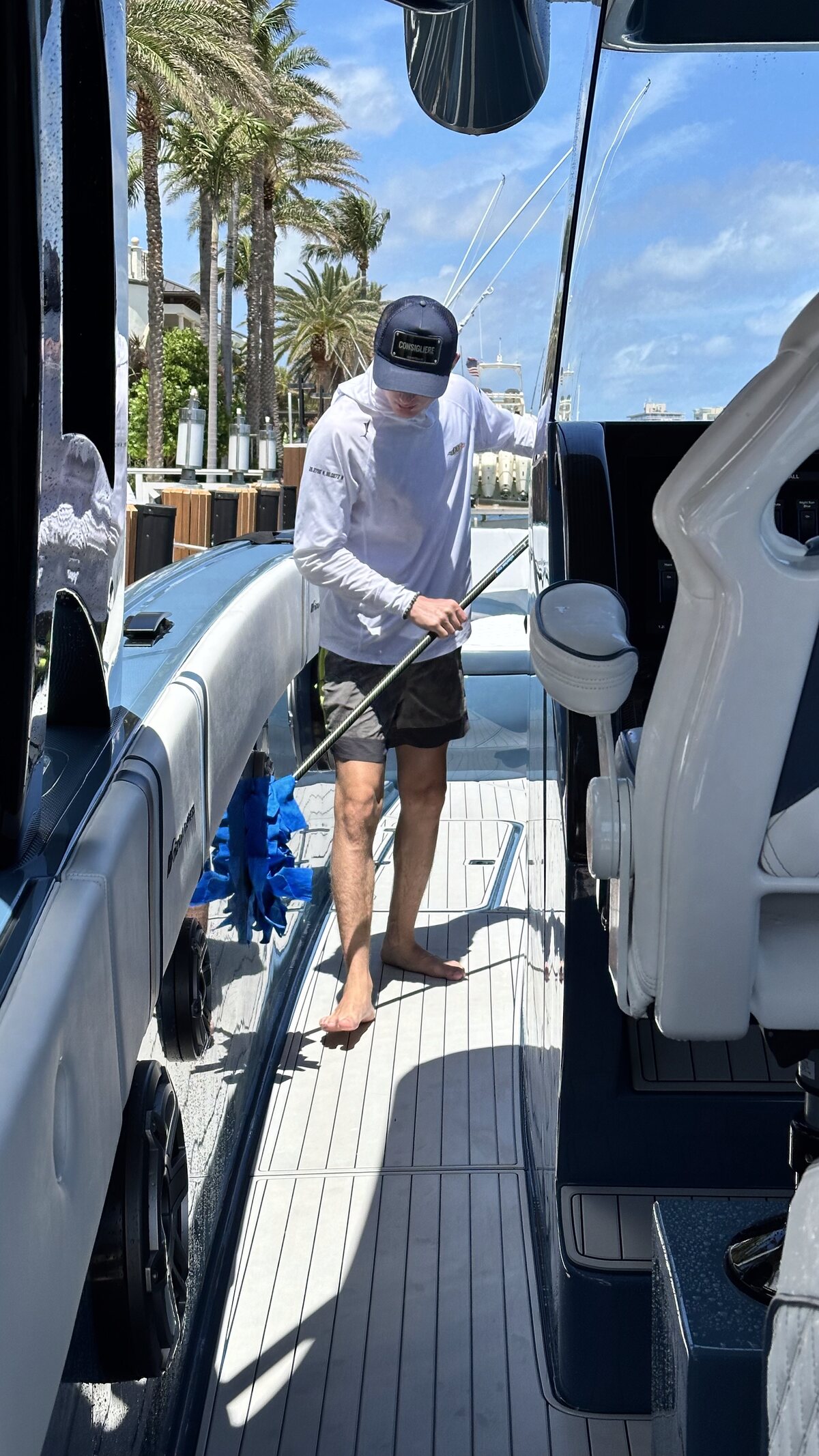
For the areas you cannot reach, use a Yot Stik and a plush brush. The plush brush has bristles on three sides instead of one, so you get contact on the surface without leaning into it at a bad angle.
I do not use the stiff white brush. The only exception is Flexiteak flooring.
The technique matters more than the tool. Be soft with the plush brush and let the fibers do the work. If you are pressing hard enough that the handle is flexing, you are grinding whatever grit is on the boat into the finish. That is where swirl marks come from, and on paint they are expensive to correct.
Nonskid gets the same treatment. A lot of people assume nonskid is the one place you can be aggressive because it is textured and it hides everything. Nonskid can be ceramic coated too, and scrubbing it hard takes that coating straight off.
Rinse your mitt out regularly. A mitt that has picked up grit is sandpaper.
Same logic applies to your rags, and this is where I would spend differently than most people. If your boat is painted, do not wash and reuse microfiber. Use it once and get new ones. A microfiber that has been through a wash cycle has picked up detergent residue and whatever grit was in the load with it, and on paint that is a scratch you pay a paint shop to correct. Order a crate of microfiber rags from Costco and treat them as disposable. It is the cheapest insurance on the boat.
Isinglass, where most of the damage happens
The clear vinyl is the most expensive square footage on the boat and it is the easiest thing to ruin in one afternoon.
Coated vinyl comes with a warranty and that warranty comes with a list. Check yours and use what your manufacturer approves. Most of the coated products have their own cleaner and their own polish, and using something else can void the coverage on panels that cost thousands to replace.
The general shape of the routine is the same across the brands:
- Rinse with fresh water after every outing
- Clean on a regular schedule with the approved cleaner
- Polish every month or two with the approved polish
The polishing step is the one everybody skips and it is the one that actually extends the life of the panels.
Stay away from household glass cleaner and anything with wax in it. If it lives under your kitchen sink, it does not belong on your enclosure.
Three things to never do. Never wipe a dry panel, because you are dragging salt crystals across a soft coated surface, so rinse first, always. Never let a brush of any kind touch it. And never let it air dry, dry it every time.
Why you dry, and what with
Never let a boat air dry.
The water out of the dock hose has minerals in it. When that water evaporates the minerals stay behind, and what they leave behind is a water spot. So the drying step is not about making the boat look finished. It is about physically removing the water before it has a chance to evaporate on the surface.
That is why drying belongs inside each section rather than at the end. If you wash the whole boat and then start drying, the first area you washed has already spotted.
The best chamois I have used are from Absorber and from Yot Stik.
Spot Zero
There is no boat length where a Spot Zero suddenly makes sense. It is not a size question, it is a question of whether spots bother you.
If you have a nice boat and you care how it looks, get one. If water spots do not bother you, you probably do not need one.
The other reason to have one is the one people do not think about until it has already happened. If a wash crew comes and they consistently miss drying the same spot, that spot turns into heavy hard water buildup. Not a mark you wipe off. A deposit you have to correct. Deionized water means a missed spot is just a missed spot.
It does not get you out of drying the boat. You still dry it. It just stops being an intensive job, and it takes a lot less time.
The part people forget is what it does for your fresh water tank. You are filling the tank with clean water instead of whatever comes out of the dock hose. Having good water on board is worth a lot on its own, and it is a bonus most people do not factor in when they are looking at the cost.
In South Florida, YachtBoss sells the dock-mounted units. They are the yacht management company I trust as a broker, and they also handle detailing if you would rather not wash the boat yourself.
What I would not do
- No pressure washing
- No dish soap. If you want your wax or your ceramic coating gone, dish soap is how you do it
- Never let soap dry on the surface
- No stiff brush except on Flexiteak
- No dry wiping the isinglass
- No letting the boat air dry
One exception to that last one, and it matters. I would rather rinse a boat and leave it wet than leave the salt on it. Drying is the goal every time. But if you are out of time and the choice is between a rinse you cannot dry and no rinse at all, rinse it. A water spot polishes off. Salt sitting on hardware for a week does not.
How often
Rinse with Salt Away after every run. Every time, not just after a long day offshore.
If the boat sits, wash it every two weeks.
If you are using it a couple of times a week, wash it once a week.
The rinse and the wash are two different jobs and people conflate them. The rinse after a run is about getting salt off before it dries on the hardware and in the water tracks. It takes a few minutes. The wash is the full boat wash down procedure above, section by section. Skipping rinses and doing a big wash once a month is the wrong trade, because the damage happens in the days the salt sits.
The gear
I use all of this on the boats I wash and run. Some of the links below are Amazon affiliate links, which means I make a small amount if you buy through them. It costs you nothing extra and it does not change what I recommend. As an Amazon Associate I earn from qualifying purchases. The Yot Stik links are not affiliate links, they are just where you buy the stuff.
- Anything from Yot Stik. The whole line is good, and none of it is on Amazon
- The plush brush, bristles on three sides instead of one
- Yot Stik Yot Blade deck squeegee
- A water blade
- A soft wash mitt
- Microfiber rags, by the crate. I buy mine at Costco. Bulk packs are on Amazon too. Single use on a painted boat
- A rubber collapsible bucket, will not scratch paint if it swings into the hull
- The Absorber chamois, and the Yot Stik chamois
- A soft hose, so it does not chafe and scratch when you drag it
- Gilmour Continuous Plastic Salt Water Nozzle. Plastic rather than metal, so it will not scratch anything it swings into. Do not buy their solid metal or brass nozzles for this, that is the whole point. Yot Stik makes a brush attachment for it, which is a nice setup
- Bioesque Marine Pro SiO2 Boat Soap. Note the SiO2, the plain Marine Pro is a different product
- Salt-Away concentrate, for the rinse after every run
- The cleaner and polish your isinglass manufacturer approves
The point
A wash is not about how the boat looks on Saturday. It is about what the finish looks like in three years, and what a buyer’s broker thinks when he walks up to it.
If you are getting ready to sell and you want an honest read on where the boat actually stands, call me.