A sea trial is not a test drive. Rather, it is the one hour in the whole transaction where the boat has to prove it works, under load, in front of you. Treat it like a test drive and you will spend it enjoying the ride and learning nothing.
Below is the boat sea trial checklist, in order, with the reasons attached. Do not let anybody rush you.
Before you leave the dock
Get there early. Most of what you will learn happens before the lines come off, and it only works if nothing was warmed up for you.
- Everything cold. Ask that nobody starts the engines before you arrive. A cold start is the most honest test on the boat.
- Bilges dry and photographed. Look in every one and note the water level. You are establishing a before.
- Shore power inlet. Unplug it yourself and feel the plug. Warm is a problem. Browning on the pins is a bigger one.
- Fuel level. You want enough to run at wide open throttle. Fuel is the seller’s cost.
- Start them one at a time. Watch the exhaust and listen for thirty seconds. White smoke that clears is normal. White smoke that hangs is not.
- Alarms. Confirm the buzzers actually sound at key on. A disabled alarm is a decision somebody made.
At the dock, in gear
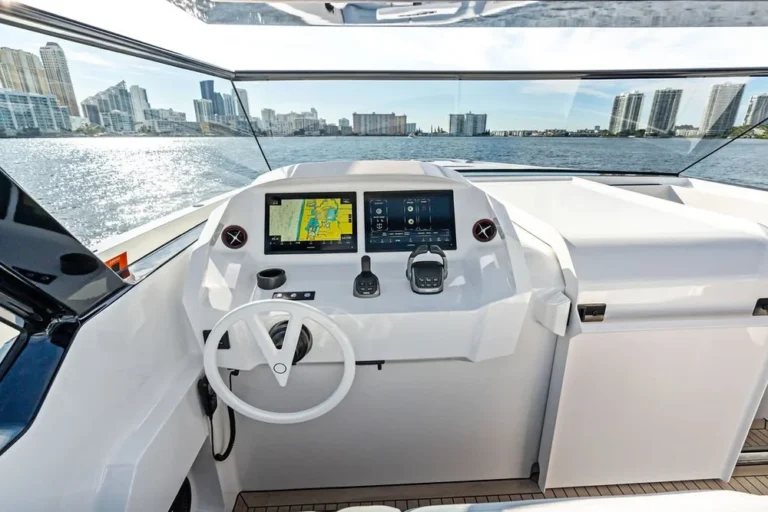
Before you go anywhere, put each engine in forward and reverse against the lines. You are feeling for a clean engagement and listening for a clunk. Meanwhile watch the tachometer for a drop that does not recover.
Then run the windlass up and down. Test both thrusters against the dock. After that, cycle the trim tabs through full travel and watch the tabs themselves rather than the indicator.
Finally, turn the wheel lock to lock and count the turns. Steering that feels notchy at the dock will not improve at speed.
Underway, and this is the part people skip
Two numbers matter more than anything else you collect all day.
RPM at wide open throttle, against the manufacturer’s spec. Say the engine is rated to turn 3,800 and it only reaches 3,450. Something is wrong. Either the boat is over propped, the bottom is fouled, the load is heavy, or the engine is tired.
Any of those is a real conversation. However, you cannot have it if you never went to full throttle.
Temperature after twenty minutes at cruise. Not after five. Raw water problems, a blocked strainer, a tired impeller and a scaled heat exchanger all show up as heat that creeps rather than heat that spikes.
So run it properly. Get on plane, hold cruise for a solid twenty minutes, then go to wide open throttle for at least a minute while somebody photographs every gauge. Afterward, back down hard, turn hard both directions, and cross your own wake.
If you want somebody in your corner for this, that is most of what a buyer’s broker does, and the seller pays for it. I explain how that works in the piece on commission.
What can actually happen out there
I flew to Lake Ozark for a client’s sea trial on an Invictus 320GT. The captain put the throttles down and I watched thick white smoke start pouring out of the port engine.
I told him what I was seeing. He said not to worry about it.
The smoke got worse. Then there was a loud bang, and that was the port engine gone. We limped back in on the other one.
Nobody was hurt, and my client did not end up owning a boat with a thrown rod in it. Even so, the part I still think about is the ten seconds where I said something and was told it was nothing. Say it anyway, and say it again.
On a different boat, a VanDutch 40 I used to look after, an exhaust hose clamp let go with buyers aboard. The engine room filled with black smoke and water.
I called 911 and Sea Tow, confirmed there was no fire, shut the engines down and checked the pumps were keeping up. Then I found the failure and rebuilt the connection with the tools on board.
I restarted that engine because the steering pump runs off it, and we ran back in through Haulover Inlet under our own power as Sea Tow arrived.
Both of those happened during a sea trial. Neither would have surfaced any other way, and in both cases the buyer was better off for it.
At anchor, with everything on
Stop somewhere and load the boat electrically the way a real weekend would.
- Start the generator and put it under load, with air conditioning on in every zone at once
- Every screen, radar, sounder and stereo on together, then watch house voltage
- Run the fresh water pump until it cycles, and check the head both directions
- Open and close every hatch, door and drawer, because water intrusion shows up as things that no longer line up
- Turn refrigeration on early, then come back at the end to see whether it actually got cold
A boat that runs beautifully but cannot hold air conditioning at anchor is a boat you will not enjoy in July.
Back at the dock, immediately
Do not let anybody tidy up while you sign paperwork. Instead, go straight below.
Open the engine room while it is still hot. Put your hand near, not on, the hose joints and exhaust risers. Look for wet where it was dry three hours ago.
Then compare every bilge against your morning photograph. Pull the dipsticks and look at the oil while it is warm. Finally, check the transom and the stripe at the waterline for anything that changed during the run.
What matters most
Ask to drive it for a little bit.
Asking the captain to drive is a running joke with my dad. When I was little we took a sunset pirate boat ride out of Marco Island, and my dad told me to go ask the captain if I could drive. I went up and asked. He said no. Ever since, any time we are on a boat, or anything else I should not be allowed to drive, I ask to drive and we both get a laugh.
On a sea trial the answer is usually yes. They will let you drive it for a little bit. The captain is ultimately in charge, but you should get a feel for the boat at the helm.
Nobody skips wide open throttle. The usual objection is that it is hard on the engine. In fact, running an engine to its rated speed is exactly what it was designed for, and a seller who is scared of that is telling you something.
Your surveyor attends. A boat sea trial checklist in your hand is not a substitute for a professional. Instead it is what lets you use one properly, because you can point at a compartment and ask them to look harder. Just know the limits of what you are buying, which I set out in what a survey covers and does not. If you still need one, the Society of Accredited Marine Surveyors keeps a searchable directory.
Found a boat you want to trial?
If you have not talked to a broker about it yet, send it to me before you book anything.
Common questions
Who pays for the sea trial?
The seller. The captain and the fuel are the seller’s cost. The buyer pays for the survey and the haul out.
How long should a sea trial be?
Long enough to get everything hot, which normally means at least ninety minutes underway. Anything shorter and the cooling system has not had time to show you a problem.
Should the survey and the sea trial be on the same day?
Usually yes, and most surveyors prefer it. The typical order is a haul out and hull inspection first, then the in water trial, so the surveyor sees the running gear before it goes back in.
What happens if something breaks during the sea trial?
That depends entirely on how your offer is written. A properly drafted agreement makes acceptance conditional on a satisfactory trial and survey. As a result you stay free to walk, renegotiate, or ask for the repair before closing.
What to do this week
Look up the wide open throttle range for your exact engine package. Write it at the top of the page.
It pairs well with the engine questions in my piece on engine hours.
If you are shopping and have not talked to a broker about a specific boat yet, get in touch before you do. Frank Christopher, 954 504 8367.