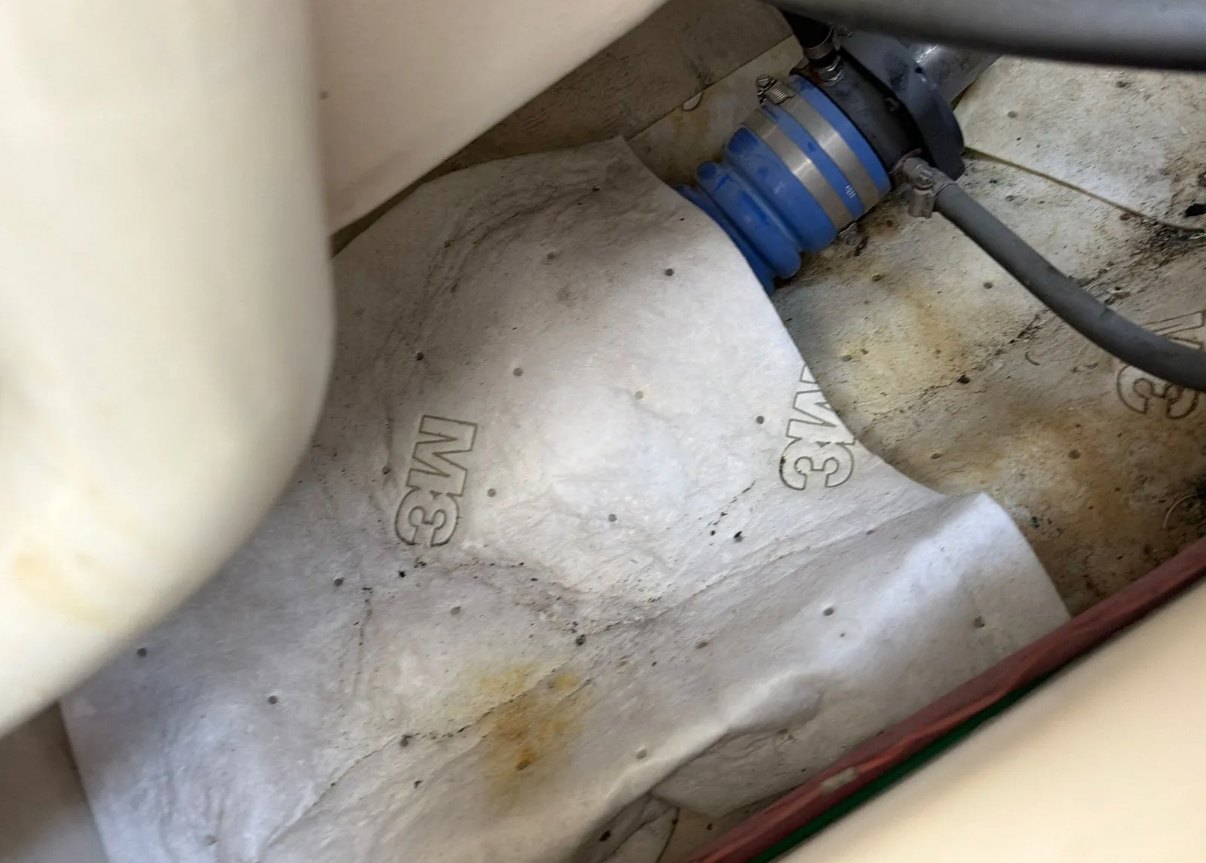
You can tell a lot in ten minutes. Not everything. But enough to know whether a boat deserves your money for a survey and a haul out. Walk it in a fixed order, look at the same things every time, and most bad boats tell on themselves before you reach the engine room. This is a filter, not a survey. It exists to stop you paying a surveyor to confirm what you could have seen from the dock.
I came into brokerage from running and maintaining boats, and I hold a USCG 100 Ton Master license. I look at a hull the way somebody who has had to fix one does. Here is the walk.
What can you tell about a boat without a survey?
You can tell how it was cared for. Care shows up in hose clamps, locker corners, bilge water and wiring, because those are places an owner only touches when he is doing the job properly. You cannot tell structural condition, moisture content, engine health or true hours.
Minutes one and two, from thirty feet away
Do not board yet. Stand back on the dock, level with the middle of the boat, and look at how she sits on her lines. Down at the stern, or with the boot stripe underwater on one quarter, is telling you something. Might be gear stowed badly. Might be water in a compartment that should be dry. Either way, ask.
Then the boot stripe itself. A hard growth line, barnacles, or a green beard below the waterline means the bottom has not been dived in months. In South Florida that is fast. Our water grows things year round, and an owner who runs his boat gets it cleaned because he can feel the drag.
Then the small stuff, which is honest. Sun rotted fenders gone chalky and gray. Dock lines furry and stiff, one eye splice replaced by a bowline. A shore power cord with tape on the collar. None of it sinks a boat. All of it says the owner defers things, and people who defer fenders defer impellers.
Minutes three and four, the deck and the hardware
Board and stay outside. Walk the side decks and put weight on them. You are feeling for anything spongy, or anything that flexes and makes a small ticking noise.
Now get down on the stanchion bases and the cleats. You want a clean bedding line where the base meets the deck. The problem signs are a fine crack out of a bolt hole, a rust colored weep track running downhill, or a base you can rock with your hand. Deck hardware that moves has been leaking, and water that gets into a cored deck does not leave.
Press the hatch and portlight gaskets. They should be soft and spring back. Hard, shrunken, cracked or squashed flat means they leak, and you will find the proof below in a minute.
Non skid worn shiny in the traffic paths is normal use. Worn shiny everywhere, pattern flat, is age, and painted non skid peeling off in sheets is a cheap fix done to sell the boat. Fine spider web crazing over a wide area is usually cosmetic. Crazing in a tight star pattern, or radiating from one point, is where something took a load. Run your thumb across the hull side. Chalk on your thumb is oxidized gelcoat nobody has compounded in years.
Minute five, the helm
Sit in the chair and look at the instruments as a set. A modern multifunction display beside a 1990s depth sounder beside a blank hole with a plate over it means things got replaced only when they died, one at a time, by whoever was cheapest that week. A helm that is all one brand and one generation means somebody did a refit on purpose.
Open the access panel under the helm if there is one. You want tidy runs and labeled wire. What tells you to slow down is butt connectors wrapped in electrical tape, wire nuts, which have no business on a boat, green fuzz on a terminal, or a spade lug hanging loose behind the breaker panel.
Then the sun covers. Supple vinyl and sound stitching mean the boat gets put away properly. No covers at all in Florida means the upholstery and the wiring have been cooking for years.
Minutes six and seven, down below
Smell first. Always smell first, before you touch a light switch or open a locker.
Damp and mildew means water is getting in and staying in. Diesel means a weep in the fuel system. A sour sewage smell means the holding tank, the vent, or permeated sanitation hose. Heavy air freshener in a closed up boat means somebody is covering something.
Now look up. Headliner stains are your leak map. A brown ring at a hatch corner or against the hull to deck joint means that fitting has leaked long enough to soak through. One fresh white patch in older headliner means somebody fixed the stain, not necessarily the leak.
Then the corners. Open every locker and put your hand flat in the bottom aft corner, where water collects and nobody wipes. You are feeling for damp, grit, or the rusty ring left by a can of something.
Then the bilge, and I want it dry. Bone dry with a film of dust is the best sign on the boat. If there is water, look at the color. Clear is probably fresh water, so a hatch or a plumbing fitting. Milky or gray with a rainbow film is oil, so an engine or a gearbox. Rusty brown has been sitting on iron. A tide mark high on the stringers means it has been much fuller than it is now.
Minutes eight and nine, the engine room
The engine room is the honest room on any boat. Nobody stages one the way they stage a saloon. Take a flashlight and take your time.
Hoses first. Squeeze a coolant hose and a raw water hose in the middle. Firm and springy is right. Mushy, hard and glassy, or crunchy under your thumb means it is done. Look for chafe where a hose crosses a bracket, and for a hose bent so tight it has gone oval.
Then the clamps. They should be all stainless, and material matters more than how many there are. If the band is bright but the screw housing is streaked with rust, that is a mixed metal automotive clamp somebody bought at a hardware store, and it is on a boat.
Belt dust next. Fine black powder on the front of the engine and in the pan below means a belt has been slipping or misaligned a long time.
Then weeping. A weep is not a puddle. It is a damp shadow, a crust, or a dried salt trail running down from a fitting. Follow it up and you find the source. On the raw water side, check the pump, the heat exchanger end caps and the strainer. Powdery white bloom on aluminum and green crust on bronze both mean salt water has been getting out a while, and it eats everything downhill of it. Check the drip pan too. A thick black film with grit in it has been leaking oil for years and getting wiped, not fixed.
Be careful with a very freshly painted engine room. New paint on the bilge, the stringers and the block, on an older boat with nothing else refreshed, proves nothing by itself. Paint covers weep trails, salt crust, rust streaks and old drips. It removes the evidence you came to read. If the whole boat says deferred and the engine room says immaculate, that mismatch is the finding.
What does a hose date code tell you, and where do you find it?
Marine fuel hose has the year it was made printed along it. Compare it to the boat’s build year.
The type code matters as much as the year. A1 and A2 are fire tested and belong in an engine room. Type B is not fire tested and does not. A hose in a fuel, raw water or potable water application with no markings at all is a finding on its own.
There is no single legal replacement interval for raw water hose, which is why the printed year matters. Original hose on a twenty year old boat, with the original clamps, is a real number in your negotiation. And through hull and hose leaks are the largest single cause of boats sinking, ahead of engine cooling leaks and groundings. Those are the hoses you are standing in front of.
Minute ten, the paperwork question
Before you leave the dock, ask for the service records. Not “has it been maintained.” Everyone says yes. Ask for the file. You want service invoices with dates and engine hours on them, from a yard or a mechanic with a name.
The answer tells you more than the boat does. A seller who hands you a folder, or emails a PDF that afternoon, has a boat that was looked after and knows it. A seller who says it was all done in house, or that the records went with the last owner, has told you that you are buying blind.
What is cosmetic, what is leverage, and what means walk away
Cosmetic: chalky gelcoat, tired non skid, rotten fenders and dock lines, worn vinyl, faded canvas, a dirty bottom. Real money, but known money, and none of it hides anything.
Leverage: hard hatch gaskets, weeping fittings, original hoses and clamps, mismatched electronics, a helm wired in butt connectors, belt dust, an oily drip pan. All fixable, all expensive enough to belong in your number.
Walk away, or at least stop before you spend anything: soft decks in more than one place. Concentrated crazing, or a repair somebody tried to hide. Headliner stains plus damp locker corners plus a wet bilge, which together mean the boat has been taking water for years. Oil or coolant in the bilge. Heavy corrosion on the raw water side. A freshly painted engine room on a boat deferred everywhere else. No records and no straight answers.
This is a filter, not a survey
I am a yacht broker. I am not a marine surveyor, and none of the above is a survey or a substitute for one.
A surveyor finds what nobody can see with a flashlight on a dock. Moisture in the deck and hull. Structural condition. The running gear once she is hauled. Corrosion you need meters to find. On any boat you are serious about, you hire an accredited surveyor and you haul her out. That is not optional.
This walk only decides which boats get that far. Every boat you rule out at the dock is money you keep for the one worth surveying.
If you are looking and have not talked to a broker about a specific boat yet, send me the listing and I will tell you what I would want to see in person.